
The Factory That Dreams: How AI & Dark Factories Will Build Anything Overnight
- by Futuristly
- in Blog, Featured
- on October 22, 2026
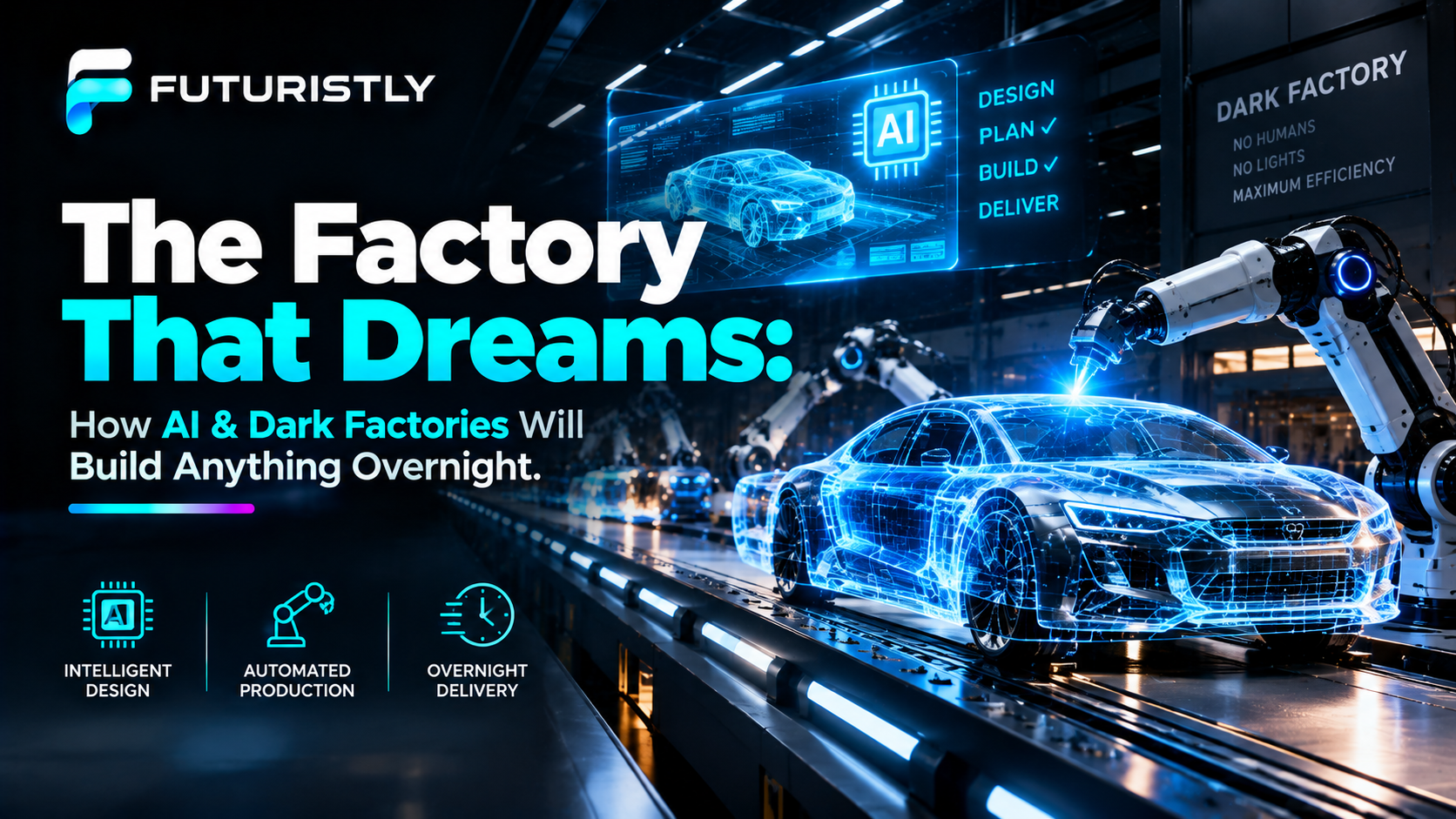
A research report on describe-it-tonight, own-it-tomorrow manufacturing
Executive summary. This report examines a single proposition: that within the next decade, a consumer will be able to describe a physical product in the evening — in words, with a sketch or a photograph — and receive a manufactured, quality-checked version of it the following morning, made for an audience of one. The proposition sounds like science fiction, but it decomposes into five technical capabilities, four of which already exist in demonstrated form: design generated from constraints by AI, design expressed directly from natural language, validation inside a simulated factory before anything physical is built, fabrication in highly automated “dark” factories, and closed-loop systems that test, learn, and iterate without human supervision. The missing capability is not any single technology. It is the integration of all five into one pipeline that works for arbitrary consumer products at a price ordinary people will pay. This report assesses the evidence for each component, identifies the genuine gaps, reviews the instructive failures of earlier attempts, and offers a staged timeline.
1. The concept
The service, as envisioned, runs on an overnight cycle. At 8 p.m., a customer describes what they want: a lamp, a shoe, a chair, a toy, a replacement part for a machine whose manufacturer no longer exists. An AI design system interprets the description, asks clarifying questions, and generates candidate designs. The customer picks one, adjusts it conversationally — longer, softer, blue, cheaper — and confirms. Through the night, the design is simulated for strength, safety, and manufacturability; a digital twin of the factory rehearses its production; robotic systems fabricate and assemble it; automated inspection compares the finished object against its digital specification. At 7 a.m., it is ready.
Two features distinguish this from ordinary e-commerce or ordinary 3D printing. First, the product does not exist in any catalogue before the customer describes it — it is designed on demand, not merely made on demand. Second, the human labour in the loop approaches zero: the customer’s description is the only human input the system requires. Everything in this report follows from asking how close industry actually is to those two features.
2. The evidence base
2.1 Machines can already design physical objectsThe oldest and most proven component is generative design: software that, given goals and constraints (weight, strength, material, cost), explores thousands or millions of geometries and returns designs no human engineer would draw. The canonical demonstration is Airbus’s “bionic partition,” a cabin divider for the A320 designed with Autodesk’s generative tools and produced by additive manufacturing: 45 percent lighter than the conventional part — about 30 kilograms per aircraft — with Airbus estimating fleet-wide fuel savings equivalent to 465,000 metric tons of CO₂ per year (Autodesk/Airbus press release). General Motors used the same class of software to collapse an eight-piece welded seat bracket into a single printed part that was 40 percent lighter and 20 percent stronger (generative design overview). NASA has applied generative methods to space hardware, including lander legs reported to be roughly 35 percent lighter than their predecessors (Electric Aviation). The pattern across these cases is consistent: for single components with clear physical objectives, AI design is not experimental — it is in production engineering today.
2.2 Machines can increasingly design from words
Generative design still requires an engineer to formalise the problem. The newer development is text-to-CAD: systems that accept a natural-language description and return an editable, parametric 3D model. Zoo’s text-to-CAD service generates CAD files from prompts; Adam, a Y Combinator startup, publishes CADAM, an open-source application that converts plain-English descriptions and image references into parametric OpenSCAD models in the browser, with dimensions exposed as adjustable sliders (CADAM repository; AI CAD tools roundup). These tools are real but shallow: they handle simple, mostly single-part objects, and their outputs serve prototyping rather than certified production. They demonstrate the interface the dreaming factory needs — description in, geometry out — at hobbyist depth rather than industrial depth. The trajectory, however, mirrors other AI modalities: the gap between a 2026 demo and a dependable tool has recently been closing in roughly two-to-four-year cycles.
2.3 Factories can rehearse production in simulation
Before anything is fabricated, the design must be checked — and increasingly, so must the factory itself. In October 2026, Siemens and NVIDIA reported results from the Siemens Electronics Factory in Erlangen, Germany, where a continuously synchronised digital twin, synthetic-data pipelines, and autonomous planning agents operate in live production rather than in a pilot; circuit-board engineering effort was reported down by up to 85 percent (TechTimes). The significance for this report is the direction of travel: the “simulate first, build once” discipline that aerospace applies to aircraft is being applied to the production line itself. A factory that can rehearse making a novel object overnight — detecting collisions, tolerance failures, and assembly problems in simulation — is precisely the validation layer a describe-it-tonight service requires.
The Erlangen figures are vendor-reported and the site is a showcase facility, so they should be read as an upper bound rather than an industry average; but the capability class is demonstrated, not hypothetical.
2.4 Factories can already run in the dark — for products they know
The fabrication layer exists in its most dramatic form in “dark factories”: plants that run with minimal human presence. Xiaomi’s Changping facility in Beijing, operating since July 2024, produces on the order of ten million flagship smartphones a year across eleven automated lines, with the company claiming 81 percent automation; independent coverage corrects the marketing claim of “one phone per second” to roughly one phone every 3.15 seconds, which remains an extraordinary rate (SlashGear). Siemens’s Amberg plant, the long-running reference case, reports production quality of 99.9988 percent (IMechE). The crucial qualification is that these factories are automated around fixed products: years of engineering went into teaching them to make one phone, one controller, perfectly. The dreaming factory needs the opposite property — equal competence at objects it has never made before. Flexible robotic assembly, including the humanoid platforms now entering production, is the industry’s current attempt to close exactly that gap, but as of late 2026 it remains the least mature layer of the five. The direction of the attempt is visible in real time: in October 2026 Mitsubishi Electric announced what it describes as the first machining system in which a general-purpose humanoid robot and CNC machine tools coordinate through physical AI, taking instructions in natural language — the operator states the task in words, an AI planner divides the work between machine and robot, and the humanoid performs setup, cleaning, part handling, and inspection (Tesla News Wire, reporting the announcement). It is a vendor claim at demonstration stage, but it is aimed precisely at the missing property: a machine that can be told what to make rather than tooled to make it.
2.5 Machines can already run the design–test–learn loop
The strongest evidence that an integrated pipeline is possible comes not from manufacturing but from chemistry, where “self-driving laboratories” have operated closed loops for years. The University of Liverpool’s mobile robotic chemist, reported in Nature in 2020, worked 21.5 hours a day in an ordinary laboratory, performed 688 experiments over eight days, and — searching a space of more than 98 million candidate experiments — autonomously discovered a catalyst six times more active than the starting point, with no human guidance (Drug Target Review). The University of Glasgow’s “chemputer” programme has similarly used machine learning to explore reaction space and identify previously unknown molecules and reactions (Manufacturing Chemist). These systems matter here because they prove the architecture: a machine that proposes a design, tests it in the physical world, interprets the result, and proposes a better one — overnight, unattended. The dreaming factory is, in essence, a self-driving laboratory whose output is a product instead of a discovery.
3. What is still missing
An honest assessment must separate the demonstrated components from the undemonstrated whole. Four gaps stand out.Complex assembly. The evidence above is strongest for single parts and simple products. A consumer product like a shoe, a lamp with electronics, or a toy with moving parts involves multiple materials, fasteners, wiring, and finishing — operations that flexible robots still perform slowly and unreliably compared with a tooled production line. This is the binding constraint, and it is a robotics problem, not a software problem.
Certification and liability. A generatively designed bracket inside an Airbus is certified through an institutional process built over years. A one-off consumer product designed at 8 p.m. has no such pathway. For low-risk goods (decor, furniture, toys without small parts) the barrier is modest; for anything electrical, load-bearing, worn on the body, or given to children, regulators will require validated design envelopes — most likely meaning the AI designs freely only inside pre certified families of products. Expect the first real services to be narrower than the dream: wide variation within guarded categories.
Unit economics. Mass production is not the incumbent by accident. A tooled line makes the millionth unit for a fraction of the first unit’s cost; a dreaming factory pays near-first-unit cost every time. Additive manufacturing and robotic assembly narrow but do not close this gap for most goods. The early market is therefore predictable: products where personalisation is worth a large premium — orthopaedic and ergonomic goods fitted to one body, replacement parts for discontinued machines, prosthetics and assistive devices, gifts and objects of personal meaning — rather than commodity goods where a catalogue item at one-tenth the price is nearly as good.
Materials and finish. Printed and robot-assembled objects still trail moulded products in surface finish, colour, and material variety. Consumers forgive this in a prototype; they are less forgiving in a product they paid a premium for.
4. Precedents, and two instructive failures
The demand side of this future has been tested before. Mass customisation — Nike’s custom shoe programmes, Adidas’s robotised Speedfactories — showed that customers enjoy configuring products but that configuration within a fixed design is a weaker desire than the industry hoped; Adidas closed its Speedfactories and moved the technology to conventional suppliers. True on demand manufacturing has sharper lessons. Local Motors built its identity around 3D-printed, crowd-designed vehicles — the purest early version of “designed by anyone, made locally” — and shut down in 2022, unable to make the economics or the regulatory path work. Shapeways, the consumer 3D-printing marketplace that let anyone upload a design and receive a printed object, went bankrupt in 2024. The pattern across these failures is instructive: in every case the technology worked at demonstration level. What failed was the combination of cost, quality consistency, and a customer proposition strong enough to beat the catalogue. Any credible forecast for the dreaming factory must assume those three problems — not the AI — decide the outcome.
5. Timeline assessment
The following staging is this report’s assessment, based on the maturity of the components
above; it is a forecast, not a finding.
Now to 2028 — the prototyping era. Text-to-CAD, generative design, and on-demand fabrication already combine into a service for prototypes and parts: describe a component, receive a printed or machined version within days. This is emerging today at professional price points and will reach consumers first as “describe a replacement part” services for the home.
2028 to 2032 — the guarded-catalogue era. Dedicated facilities pair AI design with flexible robotic assembly for defined product families — footwear fitted to scanned feet, ergonomic furniture, assistive devices, personalised sporting goods — where the design varies freely inside certified envelopes and the premium justifies the cost. Overnight turnaround becomes realistic in major cities for these categories.
2032 and beyond — the general era, if robotics matures. General-purpose overnight manufacturing of arbitrary simple products depends on flexible assembly reaching production line reliability, and on certification frameworks for AI-designed goods. Both are plausible; neither is scheduled. Complex multi-system products (anything with serious electronics, safety functions, or hundreds of parts) remain catalogue goods well past this horizon.
6. Second-order effects
If the staged forecast is even roughly right, the interesting consequences are not logistical but cultural and legal.
Taste becomes the scarce input. When design generation is cheap, the value moves to the judgement that selects and refines — the same shift photography underwent when cameras became universal.
Brands weaken at the object level. A product designed from a personal description carries no designer’s signature to signal status; status migrates to the service whose factory dreams best, and to visible craftsmanship in the categories machines still do badly.
Intellectual property law strains. A lamp generated from the prompt “in the style of” a living designer, manufactured once, for one home, sits awkwardly in frameworks built for mass reproduction; expect litigation before legislation.
Waste changes shape. One-off objects have no spare-parts ecosystem and limited recyclability, but they also eliminate the overproduction waste of catalogue manufacturing — the unsold inventory that is a substantial fraction of all goods made. A dreaming-factory economy trades warehouse waste for bespoke waste, and which is smaller is an empirical question nobody can yet answer.
Finally, the geography of making shifts again: a design-and-fabricate service has no reason to sit near cheap labour and every reason to sit near its customers, which points toward small automated plants distributed through wealthy cities — manufacturing returning to the neighbourhood as a utility, a century after it left.
7. Conclusion
“The Factory That Dreams” is best understood not as a single invention awaiting an inventor, but as an integration problem whose parts have quietly matured in separate industries: aerospace-approved AI can design better parts; chemistry proved machines can run the propose-test-learn loop unattended; electronics proved factories can run dark; and the newest text-to-CAD tools proved a customer can speak a design into existence, at least in simple form. The robot assembly of arbitrary products, the certification of one-off goods, and economics that beat the catalogue are the three walls still standing — and the history of Local Motors and Shapeways warns that those walls, not the AI, will set the date.
The most probable future is therefore a staged one: overnight parts first, overnight personal products in guarded categories next, and the full dream — describe anything in the evening, hold it in the morning — arriving last, city by city, category by category, rather than all at once. The factories have learned to run in the dark. Teaching them to dream is the work of the next decade.
References
Autodesk / Airbus — “Autodesk and Airbus show the future of aerospace design and manufacturing in pioneering generatively designed 3D printed partitions.” https://www.airframer.com/news/release/autodesk-and-airbus-show-the-future-of-aerospace-Design-and-manufacturing-in
Complete AI Training — “Generative Design Explained: How AI Is Transforming Engineering and Product Development” (General Motors seat bracket case). https://completeaitraining.com/news/generative-design-explained-how-ai-is-transforming/
Electric Aviation — “How AI and Generative Design Are Reshaping the Future of Aircraft” (NASA generative-design applications). https://electricaviation.org/ai-and-generative-design-are-reshaping-the-future-of-aircraft/
TechTimes — “NVIDIA, Siemens Prove Autonomous Factory AI Needs No Prototypes; Erlangen Engineering Down 85%” (October 2026). https://www.techtimes.com/articles/329237/20261020/nvidia-siemens-prove-autonomous factory-ai-needs-no-prototypes-erlangen-engineering-down-85.htm
SlashGear — “How Xiaomi’s Dark Factory Robots Can Pump Out A Phone In Mere Seconds.” https://www.slashgear.com/2144548/xiaomi-smartphone-robot-dark-factory-how-works-makes-phones-fast/
IMechE — “Inside the rise of unmanned ‘dark factories'” (Siemens Amberg quality figures). https://www.imeche.org/news/news-article/inside-the-rise-of-unmanned-dark-factories
Drug Target Review — “Robot researcher discovers new highly active catalyst” (University of Liverpool mobile robotic chemist, Nature, 2020). https://www.drugtargetreview.com/news/64663/robot-researcher-discovers-new-highly-active-catalyst/
Manufacturing Chemist — “Robot chemist discovers new molecules and reactions” (University of Glasgow chemputer programme). https://manufacturingchemist.com/robot-chemist-discovers-new-molecules-and-reactions-145153
CADAM (Adam) — open-source text-to-CAD application repository. https://github.com/Adam
CAD/CADAMThe CAD Hub — “Best AI CAD Software in 2026: Text-to-CAD, Drawing Automation & Copilots” (Zoo, AdamCAD, Leo AI). https://thecadhub.com/blog/smarter-cad-with-ai/
Tesla News Wire — “Mitsubishi Electric humanoid robots + CNC machines: JIMTOF 2026” (October 2026). https://teslanewswire.com/articles/mitsubishi-electric-humanoid-robots-cnc-machine-tools-physical-ai-jimtof-2026-oct-21
Tags: additive manufacturing, AI 3D printing, AI hardware design, automated robotics, autonomous manufacturing, bespoke manufacturing, closed loop systems, dark factories, digital twins, factory simulation, future of engineering, future tech 2026, futuristly, Futuristly Team, generative AI manufacturing, industrial automation, on demand manufacturing, physical AI, predictive modeling, smart factories, text to CAD, The Factory That Dreams, www.futuristly.com
